
Better Note-Taking for Language Learners
98 views
You understood the lesson. At least it felt that way.
Three days later, you remember almost nothing except one unfamiliar word that looked interesting at the time. The notebook is full. The notes aren't helping.
That disconnect frustrates almost every language learner at some point. The problem usually isn't motivation. It's how information gets captured in the first place. A page packed with translated vocabulary, grammar rules copied from a textbook, and random example sentences creates the illusion of progress. Memory doesn't work that way.
After experimenting with handwritten notebooks, digital note apps, flashcards, voice recordings, and even sticky notes scattered around a desk, one pattern became obvious: fewer notes often produce better results—as long as they're organized around retrieval instead of storage.
Stop Collecting Words Like Souvenirs
A surprising number of learners build vocabulary lists that they never read again.
Casa = House
Libro = Book
Comer = Eat
Looks organized.
Not particularly useful.
Your brain rarely recalls isolated translations during real conversations. Instead, it retrieves language through situations, emotions, and repeated exposure.
Compare those notes with something like this:
Word | Context | Personal Cue |
|---|---|---|
casa | Volví a casa tarde. | I got home late after work. |
libro | Este libro es difícil. | Reading my first novel. |
comer | Vamos a comer ahora. | Lunch with friends. |
The vocabulary hasn't changed.
Everything else has.
That tiny amount of context gives your memory more paths to retrieve the word later.
Your Notes Should Trigger Recall, Not Replace It
Many beginners copy entire grammar explanations from websites or textbooks.
I've done it too.
Several pages later, I'd realize I was creating a second textbook.
Instead, write prompts that force your brain to reconstruct the information.
Rather than this:
The imperfect tense describes habitual actions in the past.
Try this:
When do I choose imperfect instead of preterite?
Can I think of three childhood memories using it?
Which verbs commonly appear with this tense?
Those questions create active recall, one of the most consistently supported learning strategies in cognitive psychology. Researchers studying retrieval practice have repeatedly found that recalling information strengthens long-term retention more effectively than rereading notes.
One Notebook Doesn't Have to Mean One Giant Mess
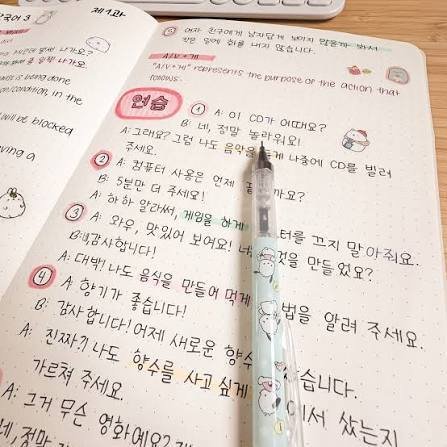
Physical notebooks still work remarkably well.
The trick is avoiding chronological chaos.
Reserve the first few pages as an index.
Leave several blank pages between major topics if possible. Number every page. Add entries as your notebook grows.
Example:
Page | Topic |
|---|---|
5 | Greetings |
12 | Present tense |
19 | Restaurant phrases |
28 | Listening mistakes |
42 | Travel vocabulary |
Simple.
Months later, finding something takes seconds instead of flipping endlessly.
Bullet journals use similar indexing systems for exactly this reason.
Digital Notes Have Different Strengths
Digital apps shine when searching becomes more valuable than browsing.
Several note-taking platforms offer features that are especially helpful for language learners.
App | Useful Features | Free Version |
|---|---|---|
Obsidian | Markdown notes, backlinks, graph view, offline storage | Yes |
Microsoft OneNote | Free-form pages, handwriting support, audio recording | Yes |
Google Keep | Quick capture, labels, reminders, OCR for images | Yes |
Notion | Databases, templates, linked pages | Yes (personal use) |
Apple Notes | Inline scans, tags, Smart Folders (iOS 15+, macOS Monterey+) | Yes on Apple devices |
Each solves a different problem.
Obsidian stores notes locally as plain Markdown files rather than locking everything into proprietary formats. Many advanced learners appreciate that because the files remain readable decades later.
Google Keep is surprisingly useful for quick vocabulary captured while commuting.
OneNote handles handwritten grammar diagrams better than many alternatives.
None of these apps magically improve memory.
They simply reduce friction.
Audio Notes Solve Problems Text Can't
Pronunciation gets neglected because typing feels faster.
Unfortunately, language isn't just text.
Record yourself saying difficult sentences.
Thirty seconds is enough.
Label recordings clearly:
French R practice
Japanese pitch accent
Spanish rolling R
Mandarin tones
Months later, those recordings become an unexpected progress tracker.
Hearing older recordings can reveal improvements that daily practice hides.
Color Coding Helps... Until It Doesn't
Many learners buy expensive highlighters.
Everything becomes colorful.
Nothing stands out.
Limit yourself.
One practical system might look like this:
Blue = New vocabulary
Green = Grammar patterns
Red = Frequent mistakes
That's it.
Adding seven different colors usually creates decoration instead of organization.
Visual consistency matters more than artistic notes.
Build Mistake Logs
This changed my own learning more than almost anything else.
Instead of recording only correct answers, create a section devoted entirely to repeated mistakes.
Example:
Mistake | Correct Version | Why It Happened |
|---|---|---|
I have 25 years. | I am 25 years old. | Literal translation from native language. |
Je suis chaud. | J'ai chaud. | Wrong expression for feeling hot. |
Estoy aburrido vs Aburro | Confused adjective and verb | Mixed up similar words. |
Patterns emerge quickly.
You'll notice the same errors returning again and again.
Fixing those recurring mistakes usually produces faster progress than learning another fifty random vocabulary words.
Screenshots Aren't Notes
Language learners often save hundreds of screenshots.
Interesting grammar explanation?
Screenshot.
Helpful Reddit comment?
Screenshot.
YouTube subtitle?
Screenshot.
Months later they're buried somewhere inside a phone gallery containing 18,000 photos.
A better workflow looks like this:
Capture the screenshot.
Extract only the useful idea.
Rewrite it in your own words.
Delete the screenshot if it no longer serves a purpose.
Ownership matters.
Rewriting forces understanding.
Connect New Information to Old Information
Brains love relationships.
Imagine learning the Spanish word lluvia (rain).
Don't stop there.
Add connections:
lluvia → rainy weather
lluvia → umbrella vocabulary
lluvia → weather forecast
lluvia → favorite rainy-day activity
Obsidian's backlink feature works particularly well for this because notes can reference each other automatically. Instead of isolated pages, your knowledge gradually becomes a network.
That's much closer to how memory actually operates.
Handwriting Still Has Advantages
Typing wins for speed.
Handwriting often wins for learning.
Research comparing handwritten and typed lecture notes has suggested that writing by hand encourages summarization instead of verbatim transcription, leading learners to process information more deeply.
That doesn't mean abandoning digital tools.
Many successful learners combine both:
Handwritten notes during lessons.
Digital organization afterward.
Flashcards for review.
Different tools.
Different jobs.
Don't Copy Native Content Word for Word
Watching a Netflix series with subtitles?
Great.
Pausing every ten seconds to copy dialogue?
Probably not.
Choose only expressions you'll realistically use.
Instead of writing an entire paragraph from a television show, capture something memorable:
"I'll get back to you."
Then add:
Formal?
Casual?
Business email?
Everyday speech?
Similar phrase: "I'll let you know."
Five useful lines beat fifty forgotten ones.
Spaced Review Beats Endless Rewriting
Many learners rewrite entire notebooks.
It feels productive.
Usually it isn't.
Reviewing information at increasing intervals produces stronger retention.
A simple schedule works surprisingly well:
Review | Timing |
|---|---|
First | Same day |
Second | 2 days later |
Third | 1 week |
Fourth | 3 weeks |
Fifth | 2 months |
Applications like Anki automate this process using a spaced repetition scheduling algorithm derived from decades of memory research. Cards you remember appear less frequently. Difficult ones return sooner.
That means less time reviewing what you already know.
More time strengthening weak spots.
Keep Notes Small Enough to Read Again
This sounds obvious.
It isn't.
If reviewing one grammar lesson takes forty-five minutes, you'll probably avoid reviewing it altogether.
Aim for notes that fit naturally into five-minute review sessions.
Short pages get revisited.
Massive documents often become archives.
There's a difference.
A Weekly Cleanup Prevents Information Decay
Language notes accumulate surprisingly fast.
Every week, spend ten minutes asking:
Which vocabulary do I already know?
Which explanations confuse me?
What keeps appearing in conversations?
Which notes deserve flashcards?
Which pages can be simplified?
Tiny maintenance sessions prevent overwhelming notebooks later.
Think of it like organizing a toolbox before it becomes impossible to find the wrench you actually need.
Frequently Asked Questions
Should I use paper or digital notes for language learning?
Neither is universally better. Handwritten notes encourage deeper processing, while digital notes make searching, linking, and syncing across devices much easier. Many learners combine both methods successfully.
Is translating every new word into my native language a bad idea?
Not necessarily. Early learners often benefit from translations. The problem appears when translation becomes the only context. Adding example sentences, collocations, or personal associations makes vocabulary much easier to remember.
How often should I review language notes?
Brief, consistent reviews outperform marathon sessions. Reviewing on the same day, then after a couple of days, a week, and later at longer intervals aligns well with established spaced repetition principles.
Which note-taking app is best for advanced learners?
Obsidian appeals to learners who like interconnected knowledge because it stores plain Markdown files locally and supports backlinks. OneNote is excellent for handwriting, while Google Keep works well for capturing quick ideas on mobile devices.
Should I keep every note forever?
Probably not. Archive reference material if needed, but regularly remove duplicate explanations, outdated examples, and vocabulary you've completely mastered. Lean notes are far more likely to be reviewed.
The best language notebook isn't the prettiest one or the one with the most pages. It's the one you'll actually open next week, next month, and six months from now. Build your notes around remembering instead of recording, and every review session starts paying bigger dividends than the last.
language note taking
vocabulary notebook ideas
grammar notes
digital study organization
language learning journal
study techniques
Found this helpful? Share it!