
Greek Terms of Endearment: How to Express Your Love in Greek
752 views
You learned σ’ αγαπώ (s’agapó) and thought you were ready to sound affectionate in Greek. Then someone calls their partner μωρό μου, their grandmother calls a teenager αγάπη μου, and a shopkeeper casually says κορίτσι μου to a customer they've never met.
Now what?
Greek terms of endearment don't map neatly onto English. A phrase that sounds intensely romantic in one context can be completely ordinary in another. My love, my child, my soul, my little one—Greek speakers use these expressions with partners, friends, relatives, and sometimes strangers.
That flexibility is part of the charm. It can also be a minefield for language learners.
This guide focuses on how affectionate Greek actually works in conversation: which words are romantic, which are family-friendly, where gender and grammar matter, and how to avoid sounding like you copied your flirting vocabulary from a badly translated subtitle.
The Greek habit of adding μου
Start with one tiny word: μου (mou).
It means “my.”
Greek often attaches μου to an affectionate noun or adjective:
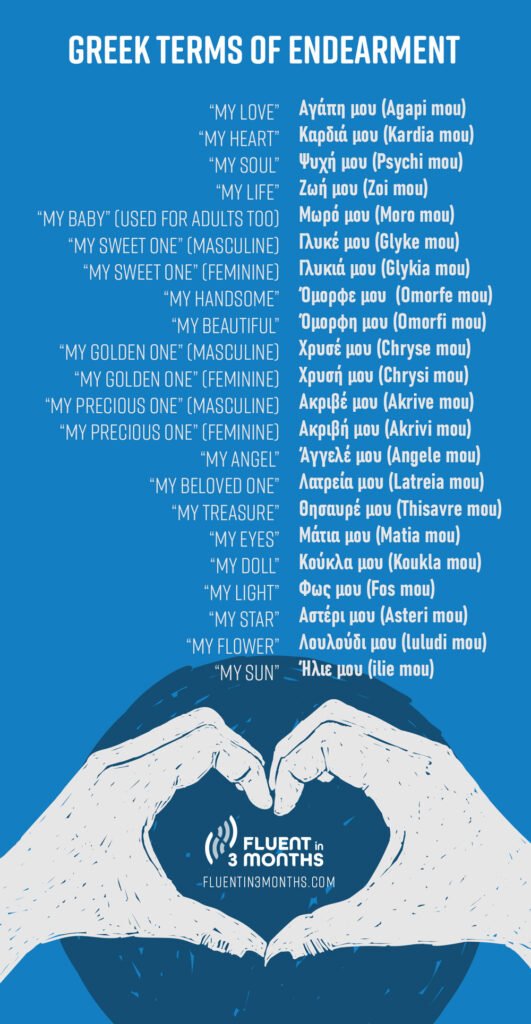
αγάπη μου (agápi mou) — my love
ζωή μου (zoí mou) — my life
ψυχή μου (psychí mou) — my soul
καρδιά μου (kardiá mou) — my heart
μωρό μου (moró mou) — my baby
Unlike English, these expressions aren't restricted to dramatic romantic declarations. A mother may say αγάπη μου to her child. A close friend may use ζωή μου. An older Greek speaker might say ψυχή μου with genuine warmth and no romantic intention whatsoever.
Context does a lot of heavy lifting.
One small pronunciation point helps, too. Greek spelling uses the Greek alphabet, so learners will encounter μου, not mou, in real messages, menus, television subtitles, and Greek-language keyboards. The romanization is useful at first, but it won't carry you very far.
The classics: Greek names for a romantic partner
Some expressions are unmistakably affectionate, especially when used repeatedly between partners.
Αγάπη μου — agápi mou
Meaning: My love.
This is one of the safest and most versatile choices in Greek. It works much like my love, darling, or love in English, depending on tone.
Example:
Καλημέρα, αγάπη μου.
Kaliméra, agápi mou.
Good morning, my love.
The noun αγάπη means “love,” and it is grammatically feminine. That doesn't mean you use it only when speaking to a woman. You can call a man αγάπη μου just as naturally.
That's a common learner mistake: confusing the grammatical gender of the word with the gender of the person receiving the affection.
Ζωή μου — zoí mou
Meaning: My life.
A little more emotionally charged. Still, Greeks may use it with close family members as well as partners.
Είσαι η ζωή μου.
Íse i zoí mou.
You are my life.
Said dramatically during an argument? That's one thing. Said softly to a spouse? Quite another.
Tone. Again.
Καρδιά μου — kardiá mou
Meaning: My heart.
This expression has a warm, almost lyrical feel in English translation, but it can sound perfectly natural in Greek speech.
Τι κάνεις, καρδιά μου;
Ti kánis, kardiá mou?
How are you, sweetheart?
It can be romantic, maternal, or simply deeply affectionate.
Μωρό μου: sweet, romantic, and very common
Μωρό μου (moró mou) literally means “my baby.”
Don't overthink the literal translation. English does the same thing.
Among couples, μωρό μου is a familiar and natural pet name:
Έλα εδώ, μωρό μου.
Éla edó, moró mou.
Come here, baby.
Greek also uses μωρό literally for a baby or infant, so context matters more than usual. Calling your partner μωρό μου is normal. Calling your Greek language teacher that after lesson three is... probably not the best use of your vocabulary.
A similar word is μωράκι μου (moráki mou), roughly “my little baby” or “my sweet little one.” The -άκι ending is a diminutive suffix, a feature you'll see constantly in affectionate Greek.
The power of Greek diminutives
Greek loves diminutives.
A suffix can make something smaller, cuter, warmer, or more affectionate. The exact effect depends on the word and context. -άκι is one of the most recognizable endings for learners.
For example:
μωρό → μωράκι — baby → little/sweet baby
αγόρι → αγοράκι — boy → little boy
κορίτσι → κοριτσάκι — girl → little girl
This isn't just a grammar exercise. Diminutives change emotional texture.
Calling someone κοριτσάκι μου (koritsáki mou, “my little girl”) might be affectionate when speaking to a child. Used toward an adult woman, though, it can sound playful, patronizing, flirtatious, or simply strange depending on the relationship.
Tiny suffix. Big consequences.
Terms that change with the person's gender
Some Greek endearments require you to match the gender of the person you're addressing. These are especially useful because they often appear in everyday speech.
Greek | Transliteration | Meaning | Used for |
|---|---|---|---|
όμορφέ μου | ómorfé mou | my handsome one | masculine |
όμορφή μου | ómorfí mou | my beautiful one | feminine |
κούκλε μου | koúkle mou | my handsome one / doll | masculine |
κούκλα μου | koúkla mou | my beautiful one / doll | feminine |
Όμορφος means beautiful or handsome, with the ending changing according to grammatical gender. The vocative form is particularly useful in direct address.
You might hear:
Καλημέρα, όμορφέ μου.
Good morning, handsome.
Or:
Έλα, κούκλα μου!
Come on, beautiful!
Κούκλα literally means “doll,” which explains the expression. In actual speech, it can function more like “gorgeous,” “beautiful,” or “sweetheart.”
Family affection can sound surprisingly romantic
Here's where direct translation breaks down.
A Greek mother may call her adult son αγάπη μου. A father may say ψυχή μου to his daughter. An aunt might greet a niece with καρδιά μου.
None of that automatically signals romance.
Ψυχή μου — psychí mou
Meaning: My soul.
This is warm and intimate, but Greek speakers use it across family relationships.
Παιδί μου — paidí mou
Literal meaning: My child.
You don't necessarily need to be someone's parent to hear this phrase. Depending on age, familiarity, and social context, an older person may use παιδί μου when speaking kindly to a younger adult.
Still, there's a social nuance here. A 25-year-old addressing a 25-year-old friend as παιδί μου would sound different from an elderly relative saying it. Don't treat every dictionary translation as interchangeable.
What Greeks actually use with friends?
Close friends may use affectionate language much more freely than English speakers expect.
Αγάπη μου and ζωή μου can appear between close friends, particularly in warm or expressive conversational styles. Women speaking to female friends may use these phrases casually, while men may choose different forms depending on friendship, region, personality, and age.
That last part matters.
There isn't a single universal “Greek personality setting.” Athens, Thessaloniki, Crete, Cyprus, family circles, workplace relationships, and individual speaking habits all produce slightly different patterns.
If your goal is natural speech, listen for what the people around you actually say.
Then borrow selectively.
A quick guide to using each term
Situation | Natural choice | Caution level |
Romantic partner | αγάπη μου | Very safe |
Romantic partner | μωρό μου | Casual and affectionate |
Romantic partner | ζωή μου | More emotionally intense |
Close family | ψυχή μου | Warm and versatile |
Child | παιδί μου | Common in family contexts |
Man you're complimenting | όμορφέ μου | Gender-specific |
Woman you're complimenting | όμορφή μου or κούκλα μου | Can be affectionate or flirtatious |
New acquaintance | None, at first | Better to wait and observe |
That final row may save you some embarrassment.
A language app can teach vocabulary. It can't always teach social timing.
How to type these terms on your phone
If you're messaging a Greek speaker, eventually you'll want a Greek keyboard rather than relying entirely on transliteration.
On iPhone, you can add Greek through Settings → General → Keyboard → Keyboards → Add New Keyboard. On Android devices, the wording varies by manufacturer and keyboard app, but Gboard supports adding Greek as an input language through its language settings.
A useful detail: Modern Greek has accents, but Greek speakers will usually understand informal messages even if you occasionally miss one. Still, typing αγάπη μου instead of agapi mou makes a message feel more natural.
Don't rush into copy-pasting dramatic phrases, though.
Καληνύχτα, ψυχή μου ❤️ may be perfect for a partner. Sending it to someone after one coffee date can change the temperature of the conversation rather quickly.
Pronunciation: don't let the spelling scare you
Greek pronunciation is more consistent than English spelling, although a few letter combinations surprise beginners.
Take ψυχή μου:
ψ sounds like ps, as in psychology.
The phrase is approximately:
psee-KHEE moo
The χ sound in ψυχή is not exactly an English “h.” It is produced farther back in the mouth and may sound somewhat like the ch in German Bach, depending on the surrounding vowel.
You don't need phonetic perfection before using an affectionate phrase. Native speakers generally appreciate a sincere attempt.
Just don't let text-to-speech apps become your only pronunciation coach. Some synthetic voices flatten rhythm and stress, which is exactly the sort of thing that makes a short, affectionate phrase sound oddly robotic.
Greek terms of endearment: FAQs
What is the most common Greek word for “my love”?
Αγάπη μου (agápi mou) is one of the most common and versatile choices. It can be romantic, but context also allows it between close family members and friends.
How do you say “my darling” in Greek?
Αγάπη μου, καρδιά μου, and ψυχή μου can all work as equivalents, although none is a perfect one-to-one translation of English darling.
Is μωρό μου only used for babies?
No. Μωρό μου literally contains the word for “baby,” but it is also a common romantic pet name, similar to “baby” in English.
Can I call a Greek friend αγάπη μου?
Possibly—but copy the relationship, not just the vocabulary. Close friends may use it naturally, while using it too early with a new acquaintance can feel overly intimate.
What does κούκλα μου mean?
Literally, it means “my doll.” In conversation, it can mean something closer to “beautiful,” “gorgeous,” or “sweetheart.” It is generally used when addressing a woman.
Start with one phrase and make it sound like you
The easiest mistake is collecting twenty Greek pet names and using all of them like vocabulary flashcards. Native speech doesn't work that way.
Pick one.
If you're speaking to a romantic partner, αγάπη μου is a strong place to start. Learn its pronunciation, hear it in real conversations, and notice what happens around it—the greeting, the tone, the relationship, the tiny pause before the word.
Then add another expression.
Greek affection lives in those details. Not just in the dictionary translation.
Greek terms of endearment
Greek love words
express love in Greek
Greek romantic phrases
Greek pet names
Greek language
learn Greek
Greek expressions
Found this helpful? Share it!